Stage 1: The dua for travel
Once you have settled into your seat, car or saddle, say this first, then the fuller travel dua once you are moving.
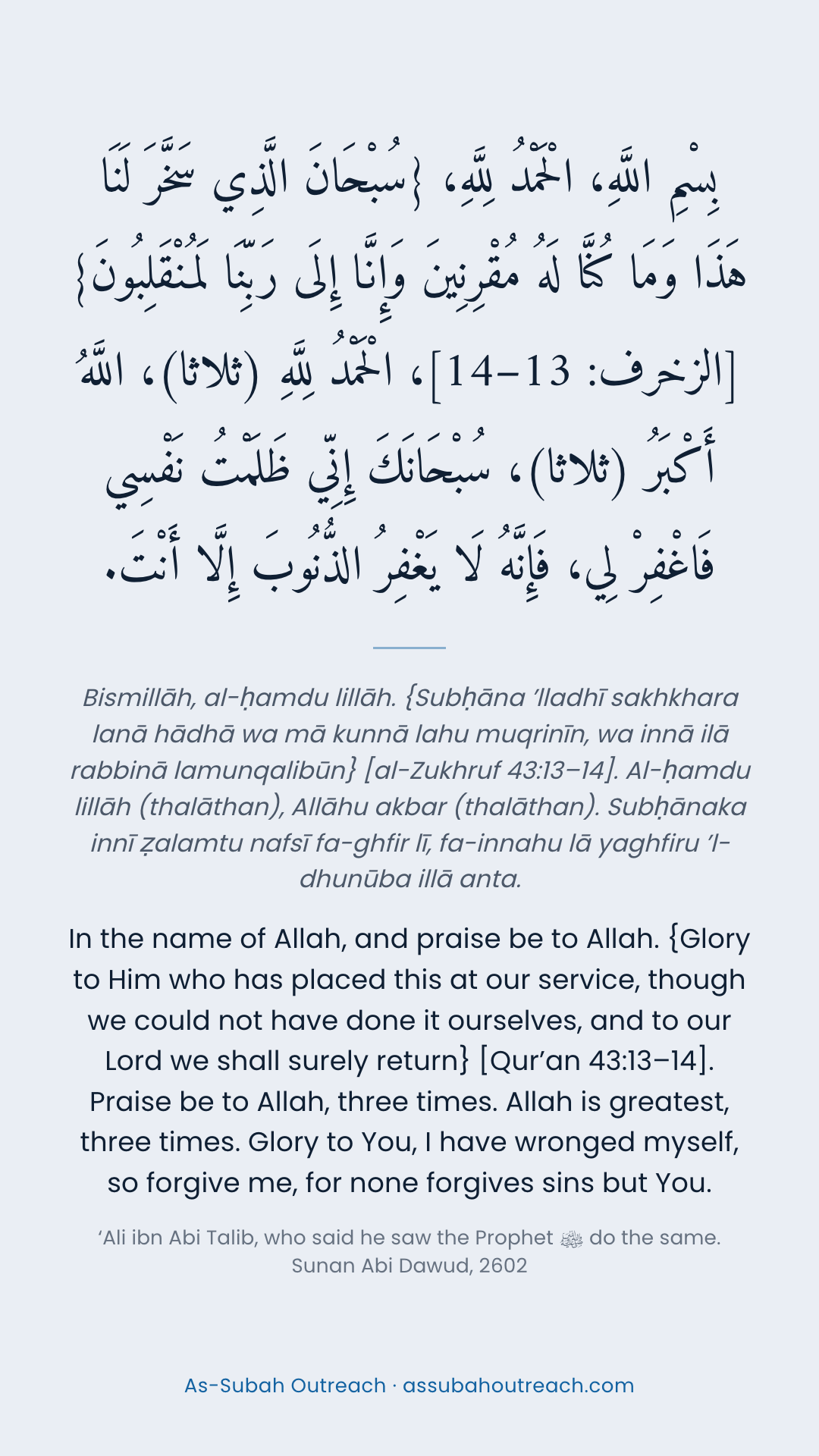
بِسْمِ اللَّهِ، الْحَمْدُ لِلَّهِ، {سُبْحَانَ الَّذِي سَخَّرَ لَنَا هَذَا وَمَا كُنَّا لَهُ مُقْرِنِينَ وَإِنَّا إِلَى رَبِّنَا لَمُنْقَلِبُونَ} [الزخرف: 13–14]، الْحَمْدُ لِلَّهِ (ثلاثا)، اللَّهُ أَكْبَرُ (ثلاثا)، سُبْحَانَكَ إِنِّي ظَلَمْتُ نَفْسِي فَاغْفِرْ لِي، فَإِنَّهُ لَا يَغْفِرُ الذُّنُوبَ إِلَّا أَنْتَ.
Bismillāh, al-ḥamdu lillāh. {Subḥāna ’lladhī sakhkhara lanā hādhā wa mā kunnā lahu muqrinīn, wa innā ilā rabbinā lamunqalibūn} [al-Zukhruf 43:13–14]. Al-ḥamdu lillāh (thalāthan), Allāhu akbar (thalāthan). Subḥānaka innī ẓalamtu nafsī fa-ghfir lī, fa-innahu lā yaghfiru ’l-dhunūba illā anta.
In the name of Allah, and praise be to Allah. {Glory to Him who has placed this at our service, though we could not have done it ourselves, and to our Lord we shall surely return} [Qur’an 43:13–14]. Praise be to Allah, three times. Allah is greatest, three times. Glory to You, I have wronged myself, so forgive me, for none forgives sins but You.
Then, once underway, say the fuller dua for the journey itself.
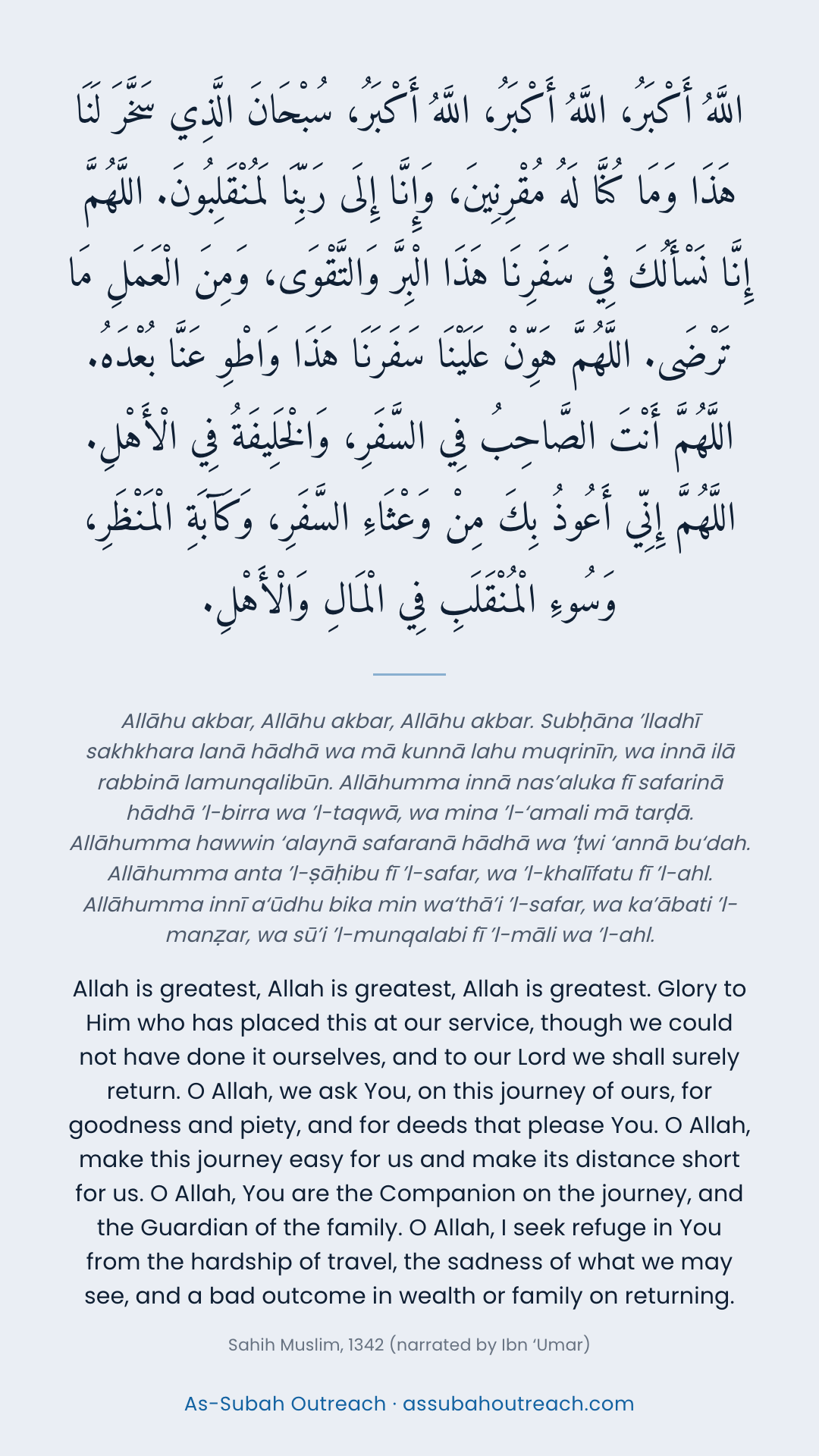
اللَّهُ أَكْبَرُ، اللَّهُ أَكْبَرُ، اللَّهُ أَكْبَرُ، سُبْحَانَ الَّذِي سَخَّرَ لَنَا هَذَا وَمَا كُنَّا لَهُ مُقْرِنِينَ، وَإِنَّا إِلَى رَبِّنَا لَمُنْقَلِبُونَ. اللَّهُمَّ إِنَّا نَسْأَلُكَ فِي سَفَرِنَا هَذَا الْبِرَّ وَالتَّقْوَى، وَمِنَ الْعَمَلِ مَا تَرْضَى. اللَّهُمَّ هَوِّنْ عَلَيْنَا سَفَرَنَا هَذَا وَاطْوِ عَنَّا بُعْدَهُ. اللَّهُمَّ أَنْتَ الصَّاحِبُ فِي السَّفَرِ، وَالْخَلِيفَةُ فِي الْأَهْلِ. اللَّهُمَّ إِنِّي أَعُوذُ بِكَ مِنْ وَعْثَاءِ السَّفَرِ، وَكَآبَةِ الْمَنْظَرِ، وَسُوءِ الْمُنْقَلَبِ فِي الْمَالِ وَالْأَهْلِ.
Allāhu akbar, Allāhu akbar, Allāhu akbar. Subḥāna ’lladhī sakhkhara lanā hādhā wa mā kunnā lahu muqrinīn, wa innā ilā rabbinā lamunqalibūn. Allāhumma innā nas’aluka fī safarinā hādhā ’l-birra wa ’l-taqwā, wa mina ’l-‘amali mā tarḍā. Allāhumma hawwin ‘alaynā safaranā hādhā wa ’ṭwi ‘annā bu‘dah. Allāhumma anta ’l-ṣāḥibu fī ’l-safar, wa ’l-khalīfatu fī ’l-ahl. Allāhumma innī a‘ūdhu bika min wa‘thā’i ’l-safar, wa ka’ābati ’l-manẓar, wa sū’i ’l-munqalabi fī ’l-māli wa ’l-ahl.
Allah is greatest, Allah is greatest, Allah is greatest. Glory to Him who has placed this at our service, though we could not have done it ourselves, and to our Lord we shall surely return. O Allah, we ask You, on this journey of ours, for goodness and piety, and for deeds that please You. O Allah, make this journey easy for us and make its distance short for us. O Allah, You are the Companion on the journey, and the Guardian of the family. O Allah, I seek refuge in You from the hardship of travel, the sadness of what we may see, and a bad outcome in wealth or family on returning.
This same wording applies to a car, a plane, a ship or any other way of travelling. Nothing in the hadith gives a separate dua worded specifically for one means of transport.
Stage 2: Leaving your family behind
When you say goodbye to those staying behind, entrust them to Allah.
أَسْتَوْدِعُكُمُ اللَّهَ الَّذِي لَا تَضِيعُ عِنْدَهُ وَدَائِعُهُ
Astawdi‘ukumu ’llāha ’lladhī lā taḍī‘u ‘indahu wadā’i‘uh.
I entrust you to Allah, whose trusts are never lost.

And those seeing you off say to you, as the Prophet ﷺ said to those leaving:
أَسْتَوْدِعُ اللَّهَ دِينَكَ وَأَمَانَتَكَ وَخَوَاتِيمَ عَمَلِكَ
Astawdi‘u ’llāha dīnaka wa amānataka wa khawātīma ‘amalik.
I entrust to Allah your religion, your trust, and the last of your deeds.

Stage 3: Arriving at a town or city
When the place you are travelling to comes into view, the Prophet ﷺ would say:
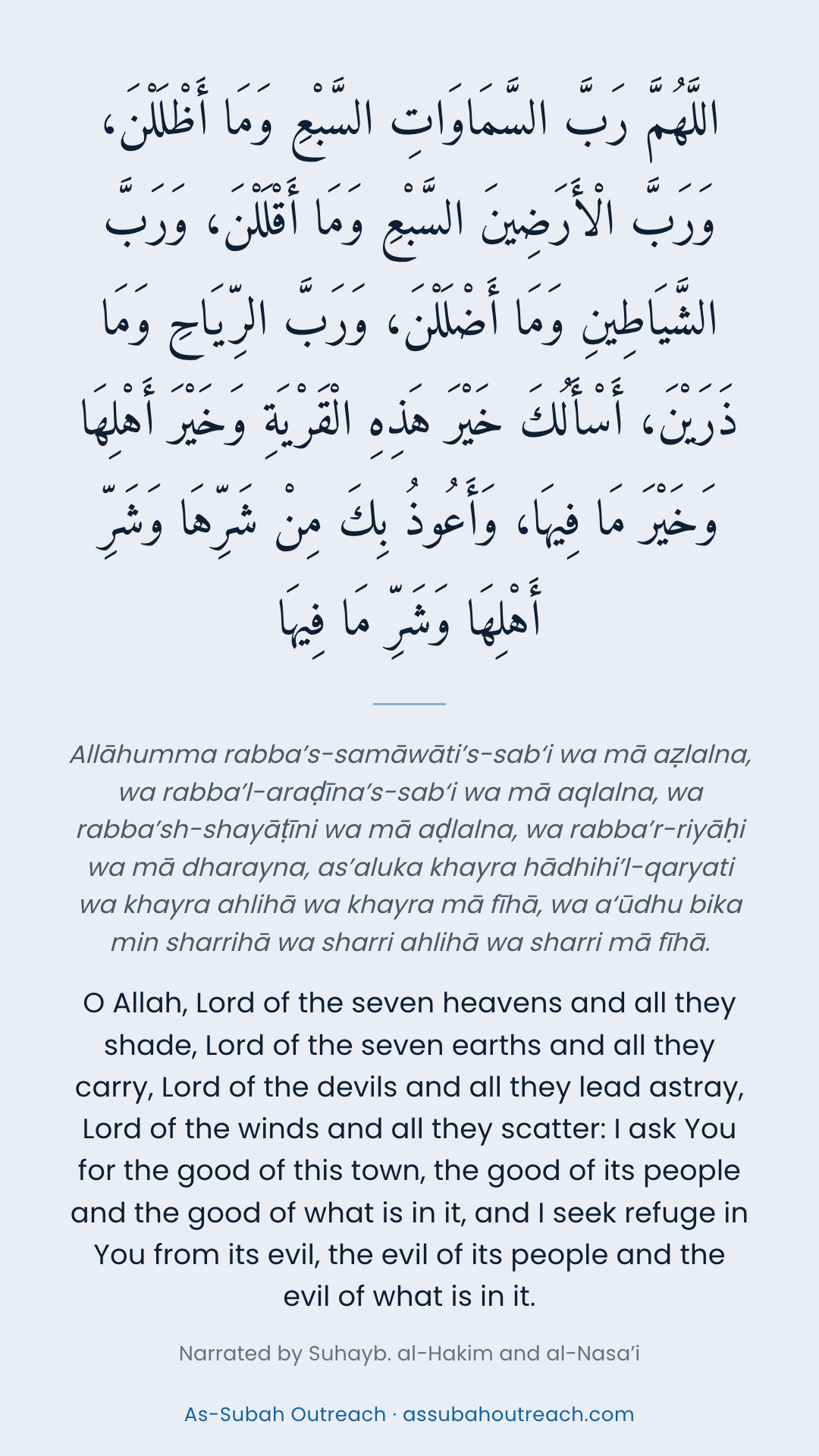
اللَّهُمَّ رَبَّ السَّمَاوَاتِ السَّبْعِ وَمَا أَظْلَلْنَ، وَرَبَّ الْأَرَضِينَ السَّبْعِ وَمَا أَقْلَلْنَ، وَرَبَّ الشَّيَاطِينِ وَمَا أَضْلَلْنَ، وَرَبَّ الرِّيَاحِ وَمَا ذَرَيْنَ، أَسْأَلُكَ خَيْرَ هَذِهِ الْقَرْيَةِ وَخَيْرَ أَهْلِهَا وَخَيْرَ مَا فِيهَا، وَأَعُوذُ بِكَ مِنْ شَرِّهَا وَشَرِّ أَهْلِهَا وَشَرِّ مَا فِيهَا
Allāhumma rabba’s-samāwāti’s-sab‘i wa mā aẓlalna, wa rabba’l-araḍīna’s-sab‘i wa mā aqlalna, wa rabba’sh-shayāṭīni wa mā aḍlalna, wa rabba’r-riyāḥi wa mā dharayna, as’aluka khayra hādhihi’l-qaryati wa khayra ahlihā wa khayra mā fīhā, wa a‘ūdhu bika min sharrihā wa sharri ahlihā wa sharri mā fīhā.
O Allah, Lord of the seven heavens and all they shade, Lord of the seven earths and all they carry, Lord of the devils and all they lead astray, Lord of the winds and all they scatter: I ask You for the good of this town, the good of its people and the good of what is in it, and I seek refuge in You from its evil, the evil of its people and the evil of what is in it.
Stage 4: The dua for returning from a journey
The travel dua above is said the same way on the way out and on the way back. The only change is on your return, when you add this line.
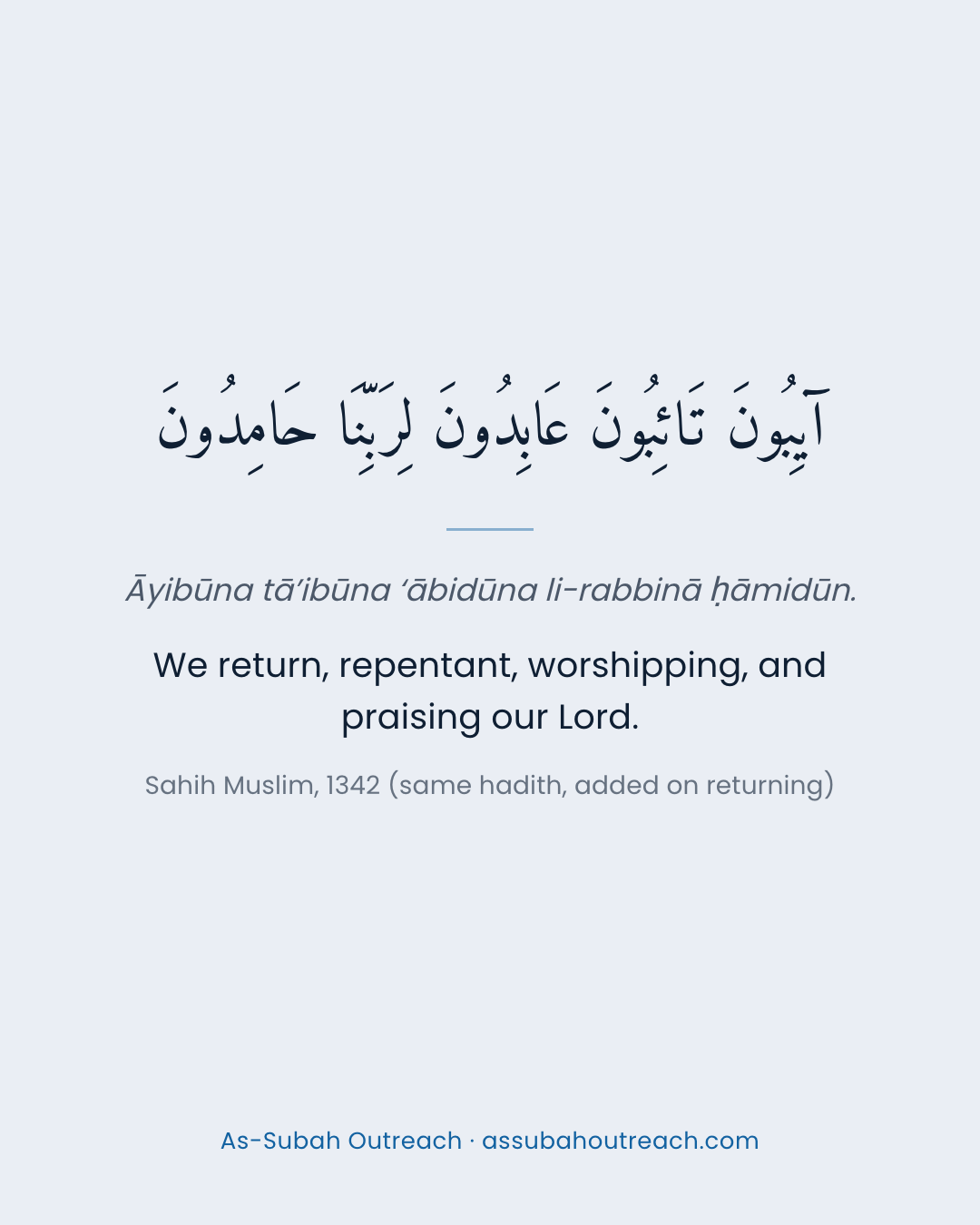
آيِبُونَ تَائِبُونَ عَابِدُونَ لِرَبِّنَا حَامِدُونَ
Āyibūna tā’ibūna ‘ābidūna li-rabbinā ḥāmidūn.
We return, repentant, worshipping, and praising our Lord.
Stage 5: Shortening your prayers while travelling
If you set out intending a journey of 48 miles (about 77 km) or more, you are a traveller. You must shorten (qasr) the fard of Zuhr, ‘Asr and ‘Isha to two rak‘ahs each; it is required, not merely allowed. Fajr and Maghrib stay as they are.2
- The distance counts, not the time. Driving or flying there in an hour does not change it.3
- Shortening begins once you have passed the built-up area of your town, and continues until you are back inside it.4
- If you intend to stay in one place for 15 days or more, you pray in full there. Less than 15 days, you keep shortening, even if your stay keeps getting extended.5
- In your hometown you always pray in full, even on a short visit.6
- Behind an imam who is not travelling, pray all four rak‘ahs with him.6
- Do not join two prayers in one time, such as Zuhr with ‘Asr. Pray each in its own time; the only exceptions are at ‘Arafah and Muzdalifah during Hajj.6
- The sunnah prayers are not shortened. Pray them when you are settled; you may leave them when you are on the move or pressed for time, though keep the two rak‘ahs before Fajr.7
- A prayer missed while travelling is made up as two rak‘ahs, even at home. A prayer missed at home is made up as four, even on a journey.6