Stage 1: What istikhara is
Istikhara means asking Allah to choose what is best. Jabir ibn ‘Abd Allah (may Allah be pleased with him) said the Prophet ﷺ used to teach them istikhara in all their affairs, the way he taught them a surah of the Qur’an (Sahih al-Bukhari, 1162).
It is for choices where you do not already know the right course: a job, a move, a proposal, a large purchase. It is not for things already known to be good, such as prayer or kindness to parents, or known to be wrong. For something already commanded, such as the Hajj, istikhara is about the timing and the circumstances, not about whether to do it.
The two rak‘ahs of istikhara are recommended, not obligatory. They are their own voluntary prayer, like the prayer on entering the mosque and the prayer of need.1
Stage 2: The du‘ā’
اللَّهُمَّ إِنِّي أَسْتَخِيرُكَ بِعِلْمِكَ، وَأَسْتَقْدِرُكَ بِقُدْرَتِكَ، وَأَسْأَلُكَ مِنْ فَضْلِكَ الْعَظِيمِ، فَإِنَّكَ تَقْدِرُ وَلَا أَقْدِرُ، وَتَعْلَمُ وَلَا أَعْلَمُ، وَأَنْتَ عَلَّامُ الْغُيُوبِ. اللَّهُمَّ إِنْ كُنْتَ تَعْلَمُ أَنَّ هَذَا الْأَمْرَ خَيْرٌ لِي فِي دِينِي وَمَعَاشِي وَعَاقِبَةِ أَمْرِي، فَاقْدُرْهُ لِي وَيَسِّرْهُ لِي ثُمَّ بَارِكْ لِي فِيهِ، وَإِنْ كُنْتَ تَعْلَمُ أَنَّ هَذَا الْأَمْرَ شَرٌّ لِي فِي دِينِي وَمَعَاشِي وَعَاقِبَةِ أَمْرِي، فَاصْرِفْهُ عَنِّي وَاصْرِفْنِي عَنْهُ، وَاقْدُرْ لِيَ الْخَيْرَ حَيْثُ كَانَ ثُمَّ أَرْضِنِي بِهِ
Allāhumma innī astakhīruka bi-‘ilmika, wa astaqdiruka bi-qudratika, wa as’aluka min faḍlika ’l-‘aẓīm, fa-innaka taqdiru wa lā aqdir, wa ta‘lamu wa lā a‘lam, wa anta ‘allāmu ’l-ghuyūb. Allāhumma in kunta ta‘lamu anna hādha ’l-amra khayrun lī fī dīnī wa ma‘āshī wa ‘āqibati amrī, fa-’qdurhu lī wa yassirhu lī thumma bārik lī fīh. Wa in kunta ta‘lamu anna hādha ’l-amra sharrun lī fī dīnī wa ma‘āshī wa ‘āqibati amrī, fa-’ṣrifhu ‘annī wa ’ṣrifnī ‘anhu, wa ’qdur liya ’l-khayra ḥaythu kāna, thumma arḍinī bih.
O Allah, I ask You to choose for me by Your knowledge, I ask You to give me ability by Your power, and I ask You of Your great bounty. You are able and I am not; You know and I do not; You are the Knower of the unseen. O Allah, if You know that this matter is good for me in my religion, my livelihood and how my affairs turn out, then decree it for me, make it easy for me, and bless me in it. And if You know that this matter is bad for me in my religion, my livelihood and how my affairs turn out, then turn it away from me and turn me away from it, decree for me the good wherever it is, and make me pleased with it.
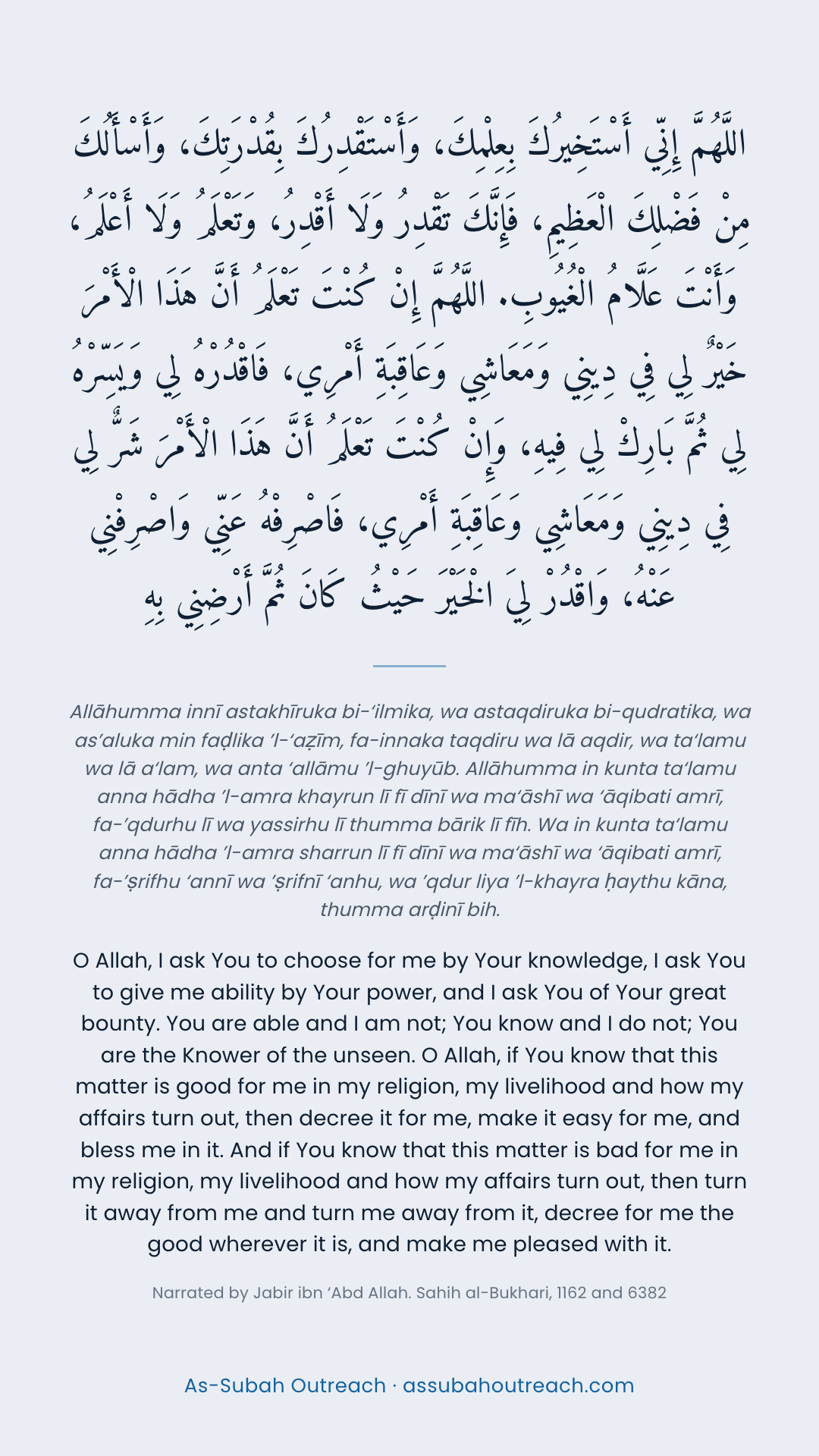
Where the du‘ā’ says “this matter” (hādha ’l-amr), name the thing you are deciding, aloud or in your heart: “this job”, “this marriage”. The Prophet ﷺ said, “and let him name his need.”
In another wording of the same hadith, “in my religion, my livelihood and how my affairs turn out” is narrated as “in my affairs now and later” (fī ‘ājili amrī wa ājilih). Either is correct.
Stage 3: How to pray istikhara
- Make wudu as for any prayer.
- Pray two rak‘ahs with the intention of istikhara, outside the obligatory prayers.
- Recite al-Fatihah and any surah in each rak‘ah. Imam al-Nawawi suggested Surah al-Kafirun in the first and Surah al-Ikhlas in the second. That is a suitable choice, but no hadith fixes the surahs.
- After the salam, praise Allah and send blessings on the Prophet ﷺ.
- Make the istikhara du‘ā’, naming your matter where it says “this matter”.
- Close again with praise of Allah and blessings on the Prophet ﷺ.
If you cannot pray, for example during menstruation, you can make the du‘ā’ on its own.
Stage 4: When to pray it
Any time voluntary prayer is allowed. As with all voluntary prayer, avoid the three disliked times: while the sun is rising until it is fully up, when it is at its height just before Zuhr, and from after ‘Asr until sunset. The night, after ‘Isha, is a calm time many choose.
Pray it when the decision is in front of you, not long before. The hadith begins, “When one of you is concerned with a matter.”
Stage 5: After you have prayed
Then go ahead with your decision, taking the ordinary means: ask people of experience, weigh it up, and trust that whatever Allah then makes easy or closes is the good you asked for. Ibn Hajar called this the relied-upon view, supported by the words “then let him resolve” in a narration from Ibn Mas‘ud.
Some scholars say to go with what your heart feels open to, and to repeat istikhara up to seven times. The report about seven times is graded extremely weak by Ibn Hajar, so it should not be treated as a sunnah.2
Worth knowing
Istikhara is not a way of receiving a sign. Dreams, colours and feelings that “confirm” an answer are not mentioned in the hadith or the books of fiqh. The answer is in what Allah makes easy for you after you have asked.
Stage 6: Istikhara for marriage
Marriage is one of the most common reasons to pray istikhara, and the method is the same: two rak‘ahs, then the du‘ā’, naming the proposal. Pray it alongside the ordinary steps the Prophet ﷺ taught: asking about the person’s religion and character, involving family, and consulting people who know them.
When the Prophet ﷺ proposed to Zaynab bint Jahsh, she said, “I will do nothing until I consult my Lord,” and went to her place of prayer (Sahih Muslim, 1428).