Stage 1: What to say when you hear of a death
Allah describes the patient as those who, when a calamity strikes them, say: “Innā lillāhi wa innā ilayhi rāji‘ūn” (to Allah we belong and to Him we return, Qur’an 2:156). The Prophet ﷺ taught a fuller du‘ā’ to say with it.
إِنَّا لِلَّهِ وَإِنَّا إِلَيْهِ رَاجِعُونَ، اللَّهُمَّ أَجِرْنِي فِي مُصِيبَتِي وَأَخْلِفْ لِي خَيْرًا مِنْهَا
Innā lillāhi wa innā ilayhi rāji‘ūn. Allāhumma ajirnī fī muṣībatī wa akhlif lī khayran minhā.
To Allah we belong and to Him we return. O Allah, reward me in my calamity and replace it for me with something better.
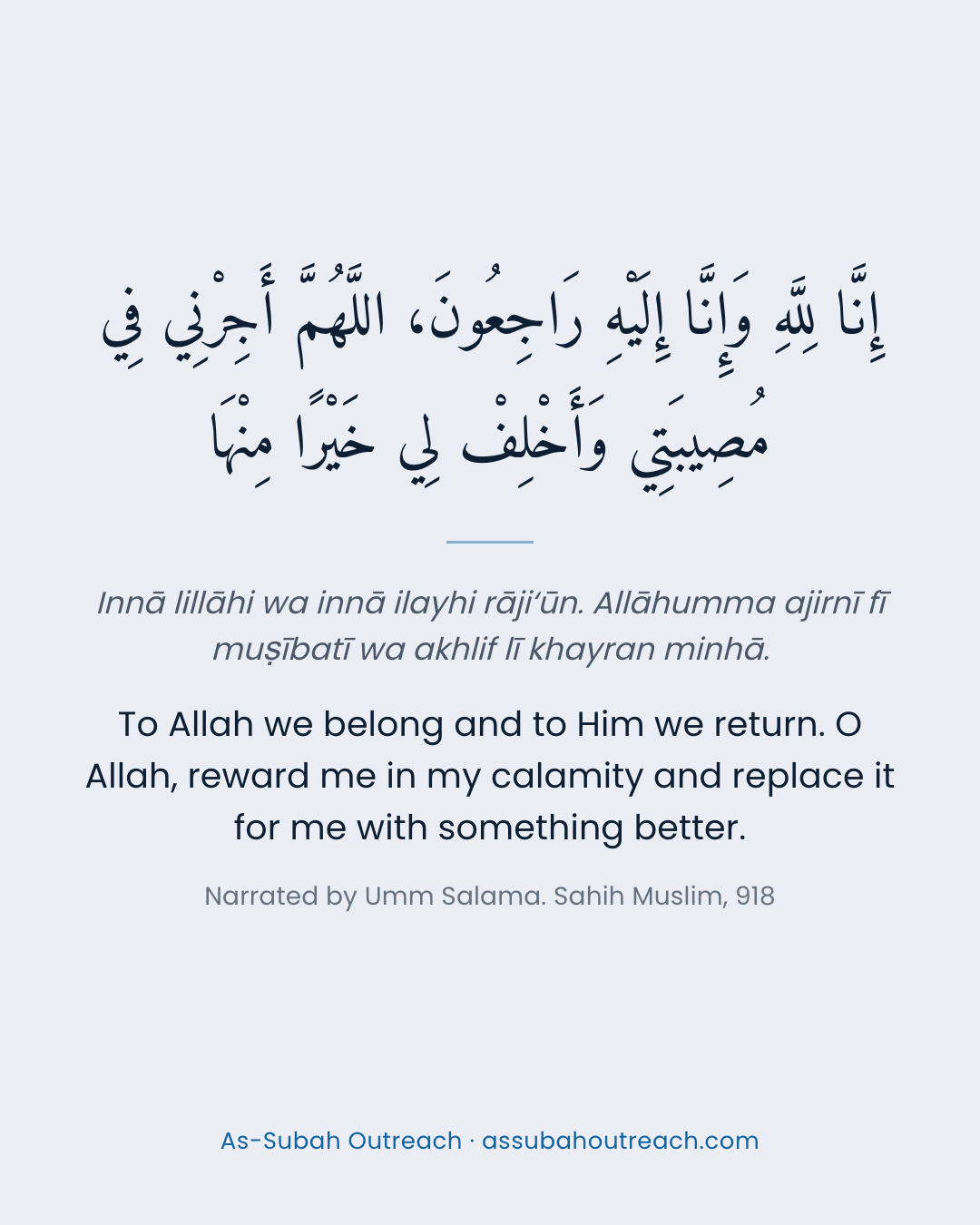
Umm Salama said this when her husband Abu Salama died, not knowing anyone better than him. Allah replaced him for her with the Prophet ﷺ himself, whom she later married.
إِذَا أَصَابَتْ أَحَدَكُمْ مُصِيبَةٌ فَلْيَقُلْ: إِنَّا لِلَّهِ وَإِنَّا إِلَيْهِ رَاجِعُونَ، اللَّهُمَّ عِنْدَكَ أَحْتَسِبُ مُصِيبَتِي، فَآجِرْنِي فِيهَا، وَأَبْدِلْ لِي بِهَا خَيْرًا مِنْهَا
Idhā aṣābat aḥadakum muṣībatun fal-yaqul: innā lillāhi wa innā ilayhi rāji‘ūn, Allāhumma ‘indaka aḥtasibu muṣībatī, fa-ājirnī fīhā, wa abdil lī bihā khayran minhā.
When a calamity befalls one of you, let him say: to Allah we belong and to Him we return. O Allah, with You I reckon my calamity, so reward me in it, and give me in its place something better.
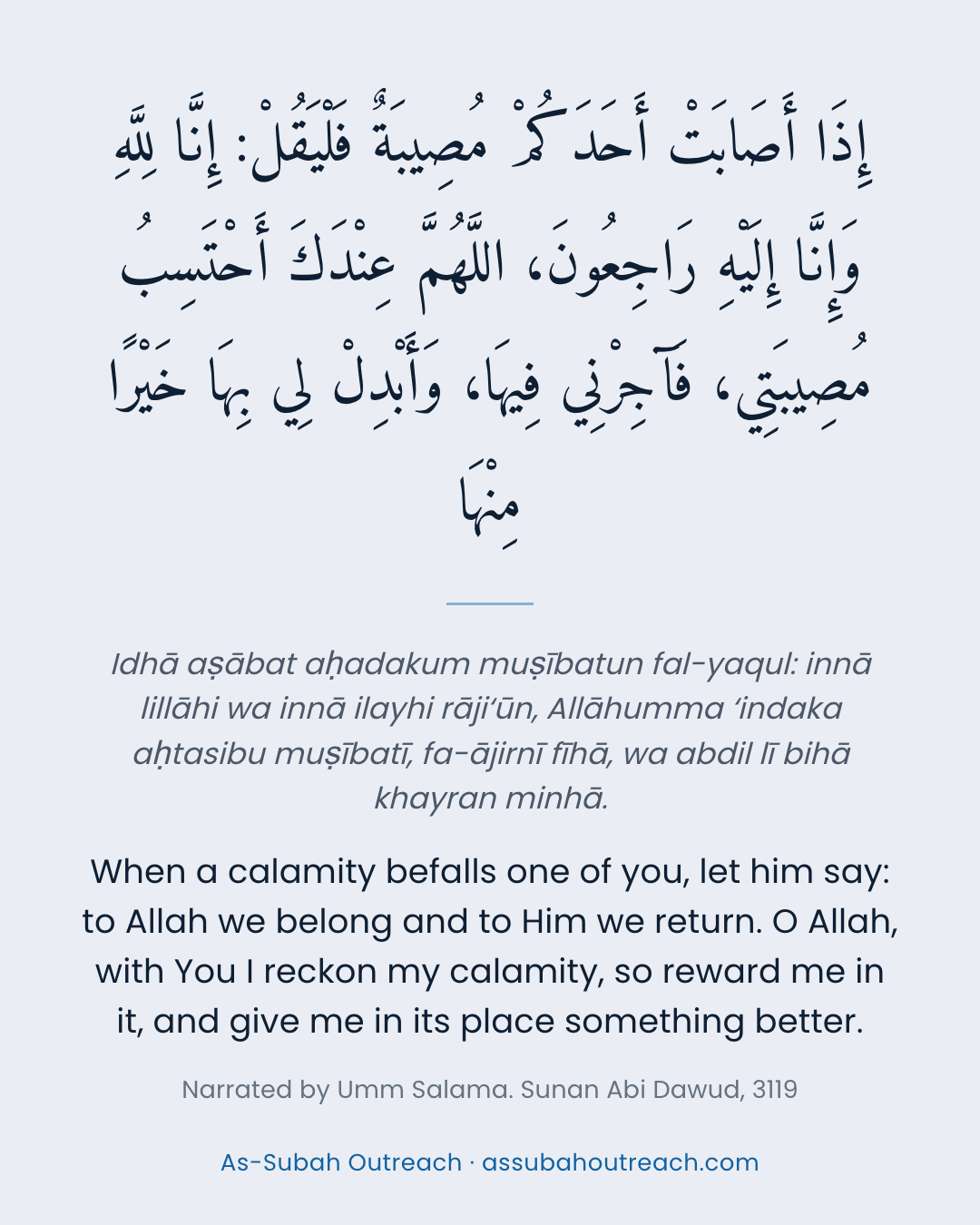
Both wordings are authentic and may be said, on hearing of any death, your own or someone else’s.
Stage 2: Consoling the bereaved (ta‘ziya)
Consoling someone who has lost a relative is recommended.1 Two hadiths are cited for its reward: whoever consoles his brother over a calamity, Allah will clothe him with garments of honour on the Day of Judgement (Ibn Majah), and whoever consoles someone in grief has a reward like his (al-Tirmidhi and Ibn Majah).
إِنَّ لِلَّهِ مَا أَخَذَ، وَلَهُ مَا أَعْطَى، وَكُلٌّ إِلَى أَجَلٍ مُسَمًّى، فَلْتَصْبِرْ وَلْتَحْتَسِبْ
Inna lillāhi mā akhadha, wa lahu mā a‘ṭā, wa kullun ilā ajalin musamma, fal-taṣbir wal-taḥtasib.
To Allah belongs what He takes and to Him belongs what He gives, and everything with Him has an appointed time. So let her be patient and seek reward.
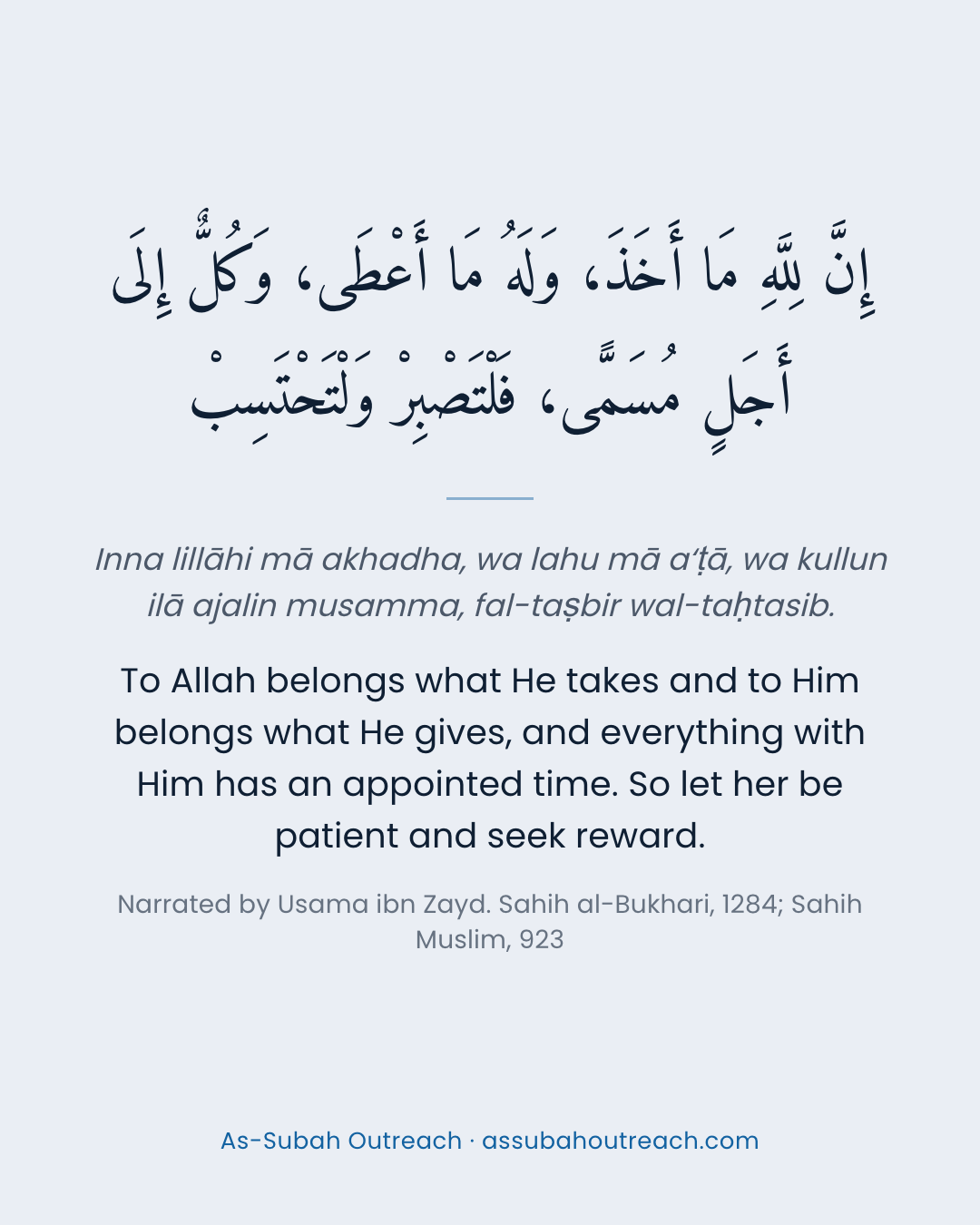
This is what the Prophet ﷺ sent back when one of his daughters asked him to come to her dying son. It is the best of all ta‘ziya wordings, better than any set formula.1
Ta‘ziya has a time limit: from the moment of death up to three days afterwards. After that it is disliked, unless the person consoling, or the person being consoled, was away and has only just returned, or unless real distress is seen, in which case it is brought forward.2
- It is disliked to console the same person a second time for the same loss.14
- It is disliked to offer condolences at the graveside itself. Ibrahim al-Nakha‘i called this an innovation: the grave is a place to recite and pray for the deceased, not to receive condolences.15
- It is disliked for the family to sit at the door of the house to receive condolences, since this was a pre-Islamic practice.16
Worth knowing
The family sitting at home for up to three days to receive visitors is permitted, though leaving it is better.3
Stage 3: Mourning with patience
Quiet weeping with a soft heart is not a sin, and is how the Prophet ﷺ himself wept when a grandchild died in his arms. Loud wailing is not permitted.
These practices belong to pre-Islamic ignorance and are not permitted: blackening the cheeks and hands, tearing the collar of one’s clothing, scratching the face, loosening the hair, scattering dust on the head, striking the thigh or chest, and lighting fires at graves. Men wearing or tearing black clothing as mourning dress is disliked; there is no harm in women wearing black.4
Stage 4: Visiting the grave
Visiting graves is recommended, on the basis of the Prophet’s ﷺ words: “I used to forbid you from visiting graves. Now visit them.” The recommended frequency is weekly, with Friday, and the days either side of it, named as the best days to go.5
For women, the answer is conditional rather than a flat yes or no. If the visit is for quiet reflection and praying for the deceased, without crying or wailing, there is no harm in it, especially for an older woman. If the visit is likely to renew grief with crying and wailing, it is not permitted.6
When you arrive, greet the people of the graves with the words the Prophet ﷺ used:
السَّلَامُ عَلَيْكُمْ دَارَ قَوْمٍ مُؤْمِنِينَ، وَإِنَّا إِنْ شَاءَ اللَّهُ بِكُمْ لَاحِقُونَ
As-salāmu ‘alaykum dāra qawmin mu’minīn, wa innā in shā’a ’llāhu bikum lāḥiqūn.
Peace be upon you, home of believing people. And we, if Allah wills, will join you.
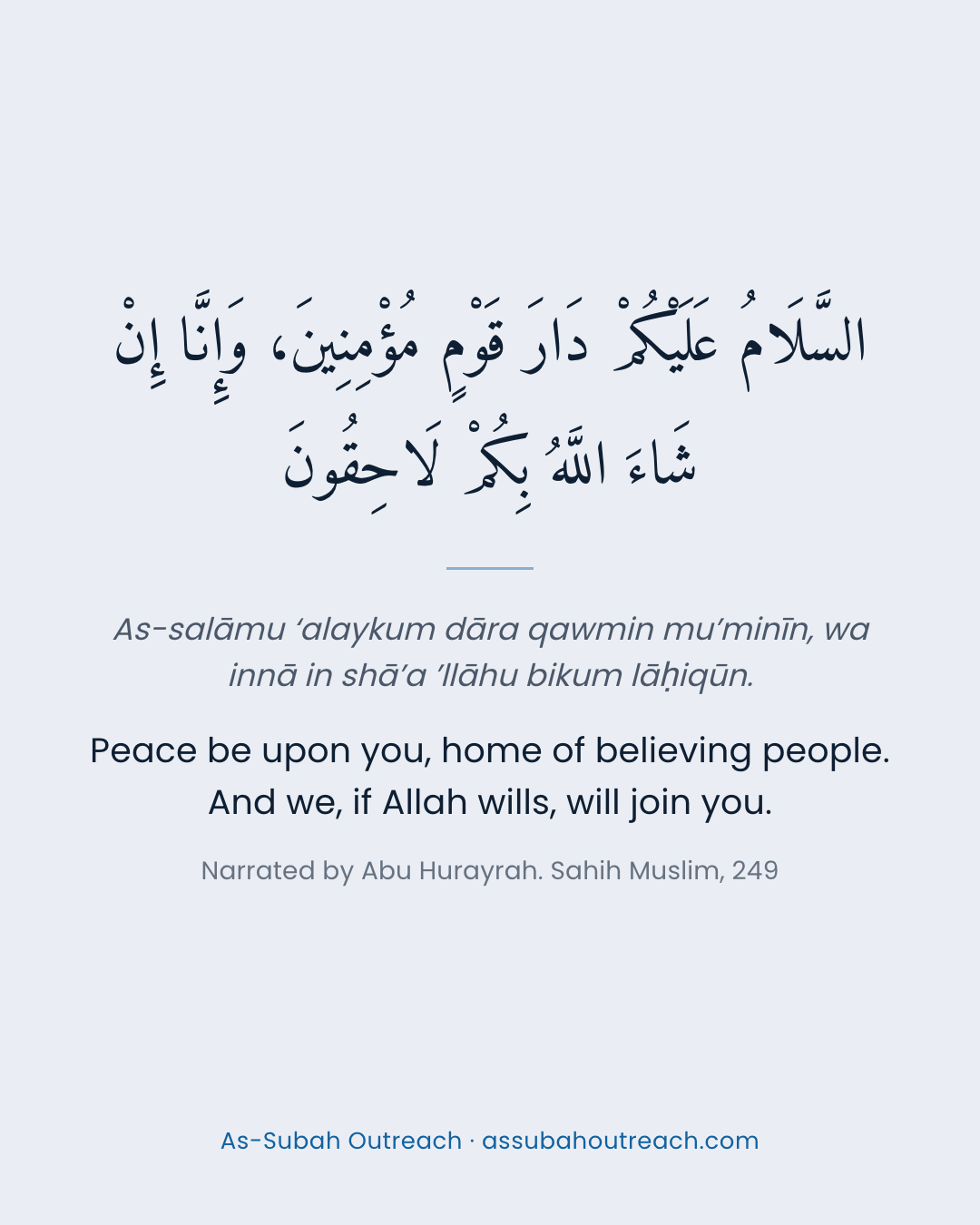
Stand while greeting and making du‘ā’, as the Prophet ﷺ did at al-Baqi‘, and to approach from the side of the feet where you can.12
Then recite what is easy for you. Surah Ya-Sin is recommended, as are the opening of Surah al-Baqarah up to “al-mufliḥūn” with its closing verses from “Āmana ’r-rasūlu”, then ask Allah to convey the reward to the person buried there.13
Stage 5: Reading Qur’an and giving charity for the deceased
The fuqaha agree that a person may assign the reward of a good deed, such as charity, Hajj, fasting or prayer, to someone who has died, and that it benefits them. This is why charity given in someone’s name, such as a sadaqah jariyah, is a genuinely sound way to give on behalf of someone who has died.
Reciting Qur’an for them works the same way: the reward of the recitation itself reaches the deceased, whether the person was named during the recitation or the reward is gifted afterwards.7
A practical way of doing this: recite what is easy, such as al-Fatihah, the opening of al-Baqarah, Ayat al-Kursi, the closing verses of al-Baqarah, Surah Ya-Sin, Surah al-Mulk, al-Takathur and al-Ikhlas (three, seven or more times), then say: “Allāhumma awsil thawāba mā qara’nāhu ilā fulān” (O Allah, convey the reward of what we have recited to so-and-so, naming the person).8
Worth knowing
Reading Surah Ya-Sin specifically for someone dying or dead is widely practised, on the strength of the hadith “Read Ya-Sin over your dying.” That hadith is weak (da‘if).9 The underlying practice of reciting Qur’an and sending its reward to the deceased stands on sound ground (above); this specific hadith naming Ya-Sin does not, and should not be presented as a command.
Stage 6: Gatherings after a death
These gatherings are disliked: preparing food on the first day, the third day, or after a week; carrying food to the grave on special occasions; and holding an invitation for Qur’an recitation where the pious and the reciters are gathered for a khatm, or to recite Surat al-An‘am or al-Ikhlas.10
The reasoning given is that hospitality was legislated for joy, not for grief, and that the Companions themselves counted routine gathering-with-food at a house of death as a form of wailing. It is, in fact, recommended that neighbours and relatives bring food to the bereaved family, not the reverse: the Prophet ﷺ said, “Make food for the family of Ja‘far, for something has come upon them that occupies them.” The bereaved family itself hosting guests with food is disliked.11
Worth knowing
The same applies to a fortieth-day gathering: it is a custom, not part of the religion.